| ISSN INTERNATIONAL |
| Online ISSN | Print ISSN |
 |
 |
| ISSN INDONESIA |
| Online ISSN | Print ISSN |
 |
 |
| IN COLLABORATION WITH |

A. Editorial Process and Publishing Workflow
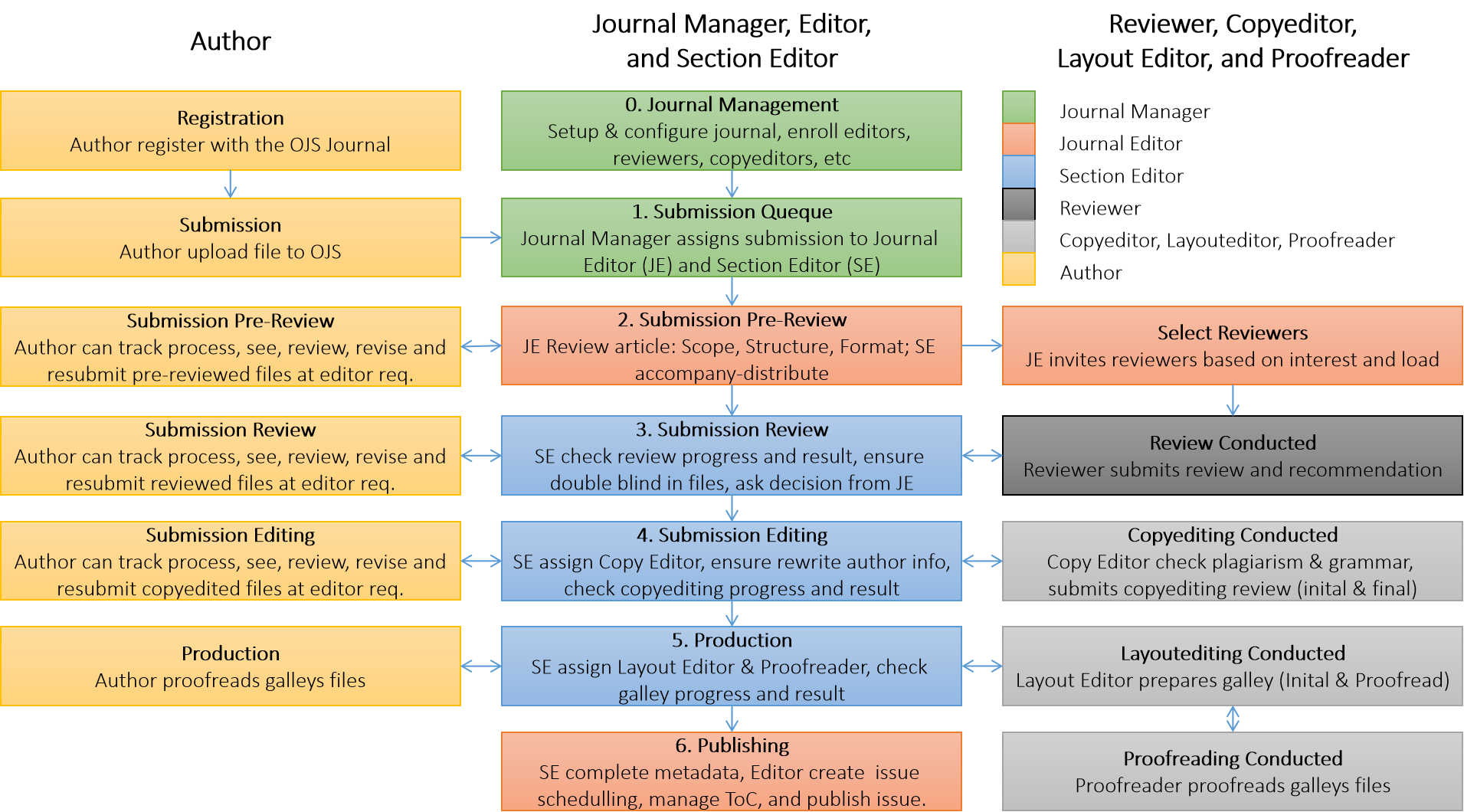
Indonesian Journal of Innovative Teaching and Learning (IJITL) is committed to upholding high standards of academic quality, originality, and scientific integrity through a transparent and structured peer review process. All manuscripts submitted to IJITL undergo a multi stage editorial workflow managed via the Open Journal Systems (OJS) platform, ranging from initial registration and editorial screening to double blind peer review by domain experts, followed by production and open access publication.
The flowchart below illustrates the detailed editorial workflow and decision making process at IJITL:
Registration and Submission Queue
(1) Author Action: Authors register an account on the OJS platform and upload their manuscript files along with necessary metadata and supporting documents.
(2) Editorial Action: Upon submission, the manuscript enters the Submission Queue, where the Journal Manager assigns the submission to the Journal Editor (JE) and/or Section Editor (SE) for processing.
Submission Pre-Review
(1) Editor Evaluation: The Journal Editor (JE) / Section Editor (SE) conducts an initial screening of the manuscript to evaluate its Scope, Structure, and Formatting compliance, as well as preliminary plagiarism check results.
(2) Select Reviewers: If the manuscript passes screening, the Editor selects and invites independent expert reviewers based on their research interest and current workload. (If it fails screening, the submission undergoes Desk Reject).
(3) Author Interaction: Authors can track progress, review feedback, revise, and resubmit pre-reviewed files as requested by the editor.
Submission Review
(1) Review Conducted: Invited reviewers evaluate the anonymized manuscript and submit their review reports along with recommendations.
(2) Editorial Decision: The Section Editor (SE) monitors review progress, ensures double-blind anonymity in all review files, evaluates reviewer recommendations, and requests/determines the final editorial decision (Accept, Minor Revision, Major Revision, or Reject).
(3) Author Interaction: Authors can track the review status, view reviewer comments, make required revisions, and resubmit reviewed files for editor re-evaluation.
Submission Editing (Copyediting)
(1) Assignment: The Section Editor assigns a Copy Editor to the accepted manuscript.
(2) Copyediting Conducted: The Copy Editor performs a secondary plagiarism check, refines grammar and style, ensures author information is correctly restored (unblinded), and submits initial and final copyediting reviews.
(3) Author Interaction: Authors review copyedited files, clarify editorial queries, and resubmit finalized copyedited manuscripts at the editor's request.
Production (Layout Editing & Proofreading)
(1) Assignment: The Section Editor assigns a Layout Editor and a Proofreader to manage the production phase.
(2) Layout Editing Conducted: The Layout Editor formats the copyedited file into the journal's official template to prepare initial and final galley proofs (PDF/HTML).
(3) Proofreading Conducted: The Proofreader performs a meticulous check of the galley proofs to eliminate any formatting or typographical errors.
(4) Author Interaction: Authors conduct a final proofread of the galley files to give final approval before publication.
Publishing
(1) Final Processing: The Section Editor completes all article metadata, and the Editor creates issue scheduling, manages the Table of Contents (ToC), registers Digital Object Identifiers (DOIs), and officially publishes the issue.
(2) Access: Published articles are made permanently available online under an Open Access license on the journal’s official website.
B. Editorial Processing Timeline
The processing time for each manuscript may vary depending on several factors, such as the responsiveness of reviewer evaluations and the promptness of authors in completing required revisions. The table below outlines the estimated average duration for each major stage within the IJITL editorial workflow, from initial submission to final online publication.
| Metric / Stage | Average Processing Time | Description |
|---|---|---|
| Submission to First Editorial Decision | 13 Days | Average time from initial manuscript submission to the first decision (Desk Reject or proceed to Peer Review). |
| Peer Review Process | 13 Days | Average duration for independent expert reviewers to evaluate the manuscript and submit their reports. |
| Submission to Acceptance | 57 Days | Average duration from submission through peer review and author revisions to formal manuscript acceptance. |
| Submission to Online Publication | 62 Weeks | Total average time from initial submission through production (copyediting, layout, proofreading) to final online publication. |
C. Editorial Decision Making Policy
Indonesian Journal of Innovative Teaching and Learning (IJITL) is committed to maintaining the highest standards of academic quality, integrity, fairness, transparency, and accountability throughout its editorial and publication processes. Editorial decisions are made independently and objectively based on scholarly merit, originality, methodological rigor, ethical compliance, and relevance to the journal’s aims and scope.
IJITL adheres to internationally recognized publication ethics standards and best practices, including:
(1) COPE (Committee on Publication Ethics)
(2) Code of Conduct and Best Practice Guidelines for Journal Editors
(3) COPE: Responsible research publication: International standards for editors
(4) COPE: Cope short guide to ethical editing for new editors
(5) COPE: Cope retraction guidelines
(6) Elsevier: Ethical Guidelines for Publication of Articles
(7) Publication Ethics of IJITL
Editorial Independence and Objectivity
The Editorial Team maintains full editorial independence in all publication decisions. Editorial decisions are based solely on the scholarly merit, originality, relevance, methodological rigor, and scientific quality of submitted manuscripts. Decisions are not influenced by commercial interests, sponsorship, political considerations, personal relationships, race, ethnicity, gender, nationality, religious beliefs, institutional affiliation, or any other non academic factors.
Conflict of Interest
Editors, reviewers, and authors are required to disclose any actual, potential, or perceived conflicts of interest that could influence their professional judgment. Individuals with conflicts of interest must not participate in the review, evaluation, or editorial decision making process for the affected manuscript. Authors are expected to disclose any financial, institutional, professional, or personal relationships that may influence the conduct, interpretation, or reporting of their research.
Confidentiality
The Editor in Chief, editors, reviewers, editorial staff, and publisher must maintain the confidentiality of all submitted manuscripts throughout the editorial and peer review process. Information regarding submitted manuscripts may be disclosed only to individuals directly involved in the editorial, peer review, production, or publication process.
Editors and reviewers must not use unpublished materials, data, arguments, or interpretations contained in submitted manuscripts for personal research or professional advantage without the explicit written permission of the authors. All manuscripts under review are treated as confidential documents and must not be shared, distributed, or discussed with unauthorized parties.
Types of Editorial Decisions
Based on the peer review reports and initial screening, the Section Editor and Editor in Chief may render one of the following decisions:
(1) Accept Submission: The manuscript is accepted in its current form without further changes.
(2) Revisions Required (Minor Revision): The manuscript is conditionally accepted pending minor revisions, which will be reviewed directly by the Editor.
(3) Resubmit for Review (Major Revision): The manuscript requires substantial revisions, after which it will undergo a second round of peer review.
(4) Decline Submission (Reject): The manuscript is rejected due to major conceptual, methodological, or ethical flaws, or lack of alignment with the journal scope.
Final Decision Authority
While peer reviewers provide critical evaluation and recommendations, the final editorial decision rests exclusively with the Editor in Chief and the designated Section Editor. Editorial decisions are based on the collective weight of reviewer feedback, scientific quality, ethical compliance, and overall contribution to the field.
Appeals and Complaints
Authors who believe an editorial decision was made based on a formal misunderstanding, factual error, or reviewer bias may submit a formal appeal. Appeals must be submitted in writing to the Editor in Chief within 14 days of the decision date, detailing point by point reasons why the decision should be reconsidered. Appeals are evaluated independently by the Editor in Chief or an unassigned senior editor, and their decision on the appeal is final.
| ISSN INTERNATIONAL |
| Online ISSN | Print ISSN |
|
|
| ISSN INDONESIA |
| Online ISSN | Print ISSN |
|
|
| IN COLLABORATION WITH |

| INDEXING & ABSTRACTING |
 |
 |
 |
 |
 |
 |
| JOURNAL METRICS |
| Days to First Decision: | 13 days |
| Review Speed: | 15 days |
| Acceptance Rate: | 73% |
| Rejection Rate: | 5% |
| Issue Per Year: | 2 |
| Number of Volumes: | 3 |
| Number of Issues: | 5 |
| Number of Articles: | 37 |
| Number of Contributors: | 51 |
| Contributing Countries: | 9 |
| No. of Scopus Citations: | 5 |
| No. of Dimensions Cite: | 13 |
| No. of Google Citations: | 77 |
| Google h-index: | 5 |
| Google i10-index: | 1 |
| Update: 2025-06-20 - 2026-02-28 |
| JOURNAL TEMPLATE |


| Contributing Countries: 9 Number of Contributors: 59 |
 |
Indonesia | (36) |
 |
Nigeria | (15) |
 |
India | (1) |
 |
South Africa | (1) |
 |
Ethiopia | (1) |
 |
Timor Leste | (1) |
 |
Brunei Darussalam | (1) |
 |
Malaysia | (1) |
 |
Morocco | (2) |
| SPONSORED BY |
Indonesian Journal of Innovative Teaching and Learning (IJITL) by Academia Edu Cendekia Indonesia (AEDUCIA) is licensed under Creative Commons Attribution-ShareAlike 4.0 International (CC BY-SA 4.0) 


JOURNAL's EDITORIAL OFFICE:
Email: ijitl.ojs@aeducia.org, ijitl.ojs@gmail.com. Mailing Address: Jl. Permana Barat IV No. 3. Kelurahan Citeureup, Kecamatan Cimahi Utara, Kota Cimahi, Bandung, Provinsi Jawa Barat, Kodepos: 40512, Indonesia. Publisher: Academia Edu Cendekia Indonesia (AEDUCIA). Email: admin@aeducia.org, cv.aeducia@gmail.com.
Phone (WhatsApp): +62857-9388-6665. Website: https://aeducia.org.
Visit the Journal Publishing Office Location:
